

Other
Cow in City XVlll
₹80,000
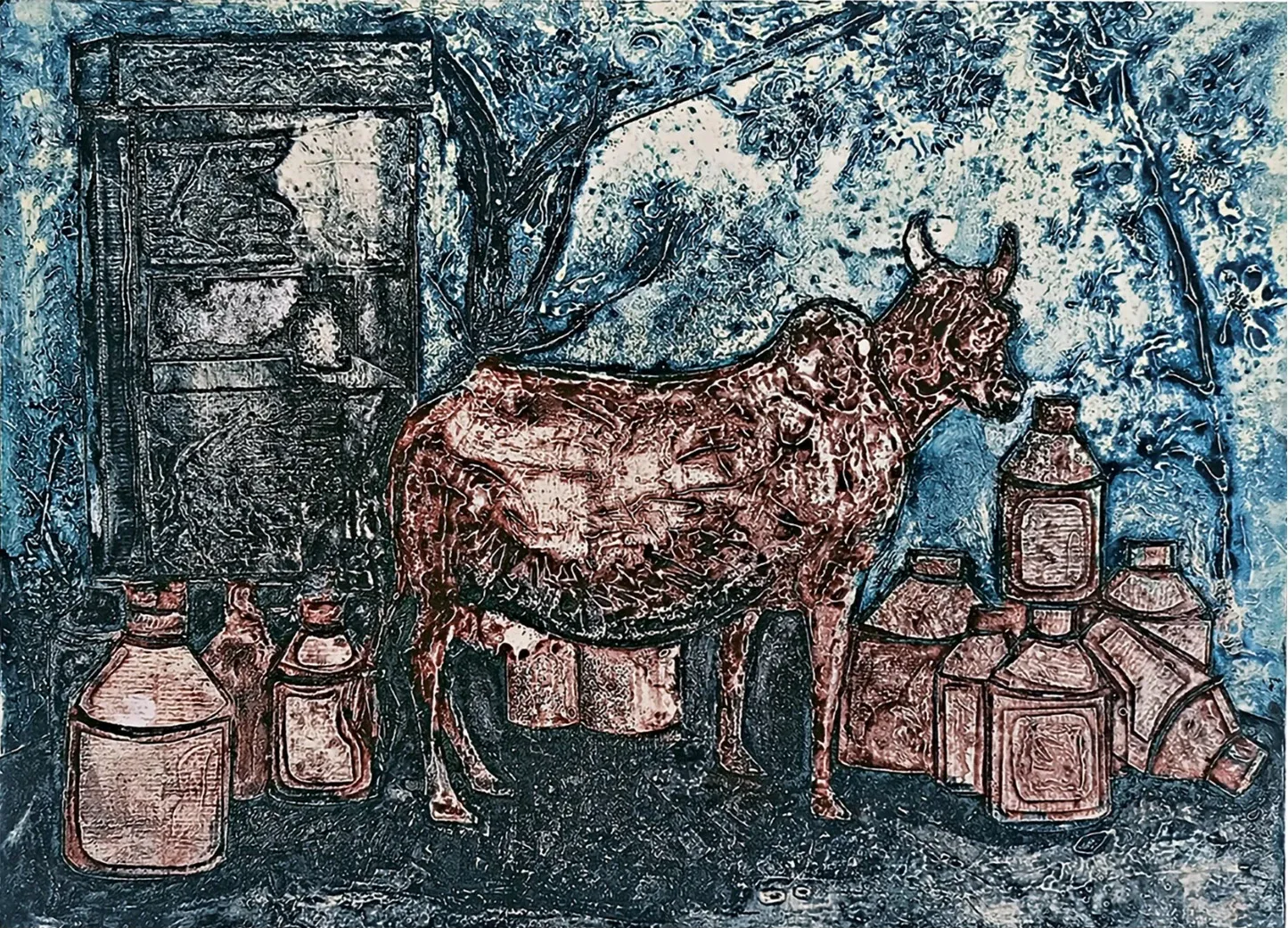
Cow in City is a powerful collagraph print that confronts India's sacred paradox. A traditionally adorned cow stands trapped between towering milk cans and skeletal trees, its body etched with fading cultural motifs. The cold metallic gleam of industrial dairy containers clashes with the decaying urban landscape, where vacant windows stare blindly. This surreal composition exposes the brutal commodification of the revered Kamadhenu - worshipped in temples yet exploited as mere milk machinery. Through textured layers of rough burlap and inked foil, the artwork screams its silent critique: our veneration has become hollow, our traditions reduced to ruthless extraction. The cow, once divine, now stands as a living monument to this betrayal.
Interested in this piece?
Chat on WhatsAppOr reach us directly at +91 79824 33408
Home visit available
Select artworks can be viewed at your home before you decide. A visit is ₹1,000 per artwork, fully adjusted against the purchase if you go ahead. See how it works.
Ask about a home visit for this pieceOr leave us a question about this piece
- Category
- Print Making
- Subcategory
- Colography
- Year
- 2024
- Dimensions
- 15 × 20 in
- Place
- Delhi
- Certificate no.
- MS-Cow in city XVlll-2024
Color palette
- Gray (78%)
- Black (9%)
- White (7%)
- Teal (6%)
Exact tones detected
Dark GrayDark GrayBlackGrayGray
Description
A sacred bovine stands frozen in the glare of urbanization—this collagraph print pulses with the dying heartbeat of rural India. The cow's rendered in tactile collagraph textures, evokes both temple idol and industrial livestock. Around it, stainless steel milk cans multiply like a mechanical halo, their polished surfaces reflecting not nourishment, but the cold calculus of dairy capitalism.
The background tells a darker story: gnarled tree branches twist like arthritic fingers, while a hybrid structure—part village shrine, part factory control panel—looms with eerie dissonance.
the work weaponizes surrealism to expose India's great bovine paradox. The collagraph medium itself turns activist—each layer of burlap, glue.cardbord, textuer white and foil mirrors society's fractured relationship with its "worshipped" animals. The raised textures don't just depict—they accuse, making tangible the exploitation hiding in plain sight beneath cultural sanctity.
In this dystopian pastoral, even the trees have become skeletal witnesses. The milk cans, though numerous, feel unnervingly weightless—containers without substance, much like the hollow rituals of veneration without welfare. This isn't just art—it's a visual indictment written in ink and glue.
Technique Highlight
This artwork employs collagraph printmaking, a dynamic process where varied materials are layered onto a plate to create rich, tactile textures. The technique shines in its ability to produce both relief and intaglio effects, giving the print a striking dimensionality—seen in the embossed furrows of the cow’s hide, the glossy, metallic sheen of milk cans, and the rough, bark-like grooves of skeletal trees. By combining materials such as burlap, foil, paper and taxtuer white,fevicol,box bord the plate captures contrasting surfaces,and creating a print enhancing the surreal tension between organic decay and industrial rigidity. The result is a painterly, deeply expressive work where texture itself becomes narrative—each raised ridge and inked crevice amplifying the piece’s critique of commodification.
Historical Context
The cow has historically been a sacred animal in Indian culture, symbolizing nourishment, divinity, and gentleness. However, in rapidly urbanizing cities, this cultural reverence often fades—cows are abandoned, displaced, or seen obstructing traffic. This artwork critiques this shift in values by highlighting the irony: an animal once worshipped now finds itself among man-made containers, representing how its natural role has been extracted, repackaged, and monetized.
The inclusion of what may resemble an abandoned shrine or machinery echoes the loss of spiritual grounding in urban environments, especially in a country like India where mythology and everyday life were once closely entwined.
Color Analysis
The palette weaves a visceral dialogue between warmth and alienation. Earthen browns—oxidized umber, burnt sienna—cloak the cow and vessels in tactile familiarity, their pigmented depth echoing clay idols and sunbaked rural life. Against this, glacial blues and void-like blacks slice through the composition, their industrial chill evoking freezer-unit barren and the metallic indifference of cities. The interplay of extreme tonal contrasts heightens the surreal tension: the cow’s body emerges sculpturally under dramatic lighting, while shadows pool like spilled ink around the milk cans, rendering them hollow receptacles rather than nourishing vessels. This chromatic duality doesn’t just depict contrast—it materializes the rift between pastoral memory and urban reality.
Symbolism
The cow stands as a sacred paradox—revered as Gaumata (divine mother) yet trapped in the machinery of mass dairy production, its holiness hollowed into utility. The gleaming milk containers, stacked like industrial totems, transmute nourishment into commodity, their sterile surfaces reflecting a system that values yield over life. Above, the fractured tree canopy—once a symbol of shelter—now withers into a skeletal relic, its shadows clawing at the cow’s back. The cabinet-like shrine, fused with cogs and switches, embodies spirituality’s surrender to automation: a temple where prayers are replaced by quotas. Even the collagraph’s tactile violence—its burlap tears and foil scars—becomes metaphor, the medium’s roughness mirroring the abrasion between tradition and progress. Here, every layer of ink and glue is the conflict itself.
- Cow: Represents tradition, sacredness, and fragility in a world where those values are eroding.
- Milk Containers: Symbolize commodification of the cow’s essence; milk, a symbol of purity, is now industrialized.
- Tree & Urban Backdrop: The natural and the constructed coexist tensely, suggesting conflict between nature and man-made progress.
- Cabinet/Structure: Could signify forgotten spirituality, modern control, or surveillance—hinting at how reverence has turned into oversight or neglect.
- Overall Composition: Creates a surreal tension between reverence and reality, between the sacred animal and its utilitarian fate in modern society.
Technique
This artwork employs collagraph printmaking, a dynamic process where varied materials are layered onto a plate to create rich, tactile textures. The technique shines in its ability to produce both relief and intaglio effects, giving the print a striking dimensionality—seen in the embossed furrows of the cow’s hide, the glossy, metallic sheen of milk cans, and the rough, bark-like grooves of skeletal trees. By combining materials such as burlap, foil, paper and taxtuer white,fevicol,box bord the plate captures contrasting surfaces,and creating a print enhancing the surreal tension between organic decay and industrial rigidity. The result is a painterly, deeply expressive work where texture itself becomes narrative—each raised ridge and inked crevice amplifying the piece’s critique of commodification.
Historical context
In Indian tradition, the cow has long been revered as a sacred and nurturing figure. This reverence stands in sharp contrast to modern urban realities, where cows are often abandoned, commodified, or neglected. The artist, while some time staying in uttar pradesh—i saw a some area place where cows are still valued and kept at home—reflects on this contrast. The hut in the background is both a personal memory and a cultural signifier of India's agrarian roots. The work comments on how sacred values are eroded by modernization and how animals lose their sanctity in concrete jungles.
Symbolism
The cow stands as a sacred paradox—revered as Gaumata (divine mother) yet trapped in the machinery of mass dairy production, its holiness hollowed into utility. The gleaming milk containers, stacked like industrial totems, transmute nourishment into commodity, their sterile surfaces reflecting a system that values yield over life. Above, the fractured tree canopy—once a symbol of shelter—now withers into a skeletal relic, its shadows clawing at the cow’s back. The cabinet-like shrine, fused with cogs and switches, embodies spirituality’s surrender to automation: a temple where prayers are replaced by quotas. Even the collagraph’s tactile violence—its burlap tears and foil scars—becomes metaphor, the medium’s roughness mirroring the abrasion between tradition and progress. Here, every layer of ink and glue is the conflict itself.
Catalogued May 16, 2025
From the same artist
More by Madhusudhan Sharma


Keep exploring
Related artworks


