

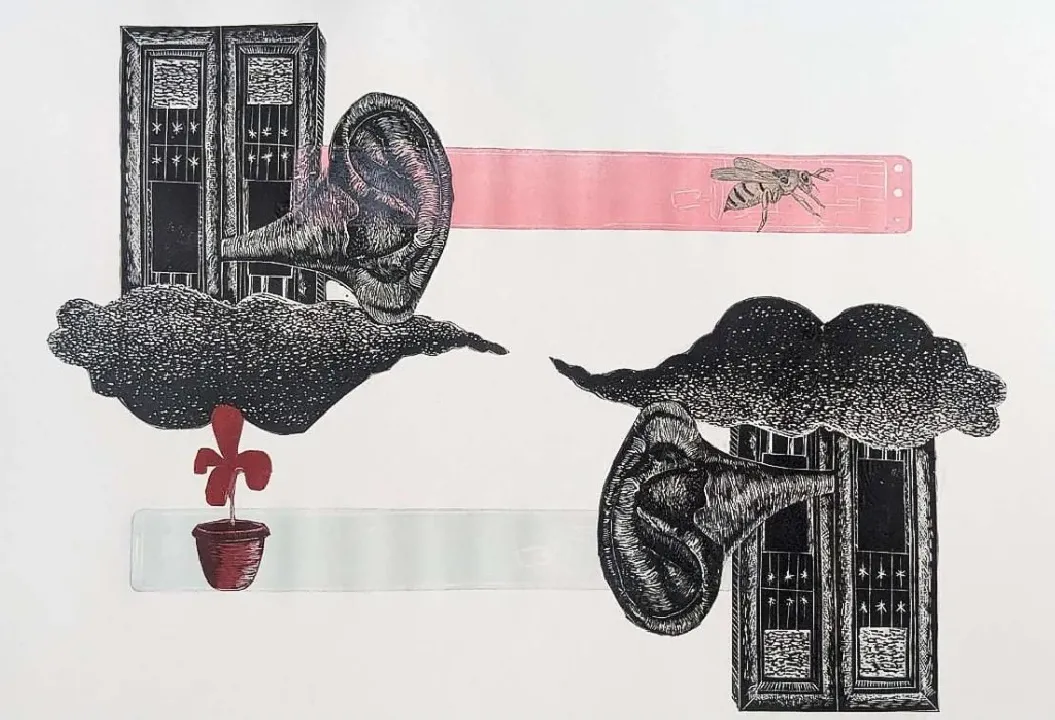
Bee in city life
Bee In City ll
₹1,80,000
A surreal woodcut composition featuring oversized human ears, architectural windows, and drifting clouds—this dreamlike image explores themes of surveillance, perception, and the quiet tension between urban life and the natural world.
Interested in this piece?
Chat on WhatsAppOr reach us directly at +91 79824 33408
Home visit available
Select artworks can be viewed at your home before you decide. A visit is ₹1,000 per artwork, fully adjusted against the purchase if you go ahead. See how it works.
Ask about a home visit for this pieceOr leave us a question about this piece
- Category
- Print Making
- Subcategory
- Woodcut
- Year
- 2024
- Dimensions
- 27 × 21 in
- Place
- Delhi
- Certificate no.
- MS-BEE-2-2024
Color palette
- White (61%)
- Gray (31%)
- Black (4%)
- Beige (4%)
- Red (1%)
Exact tones detected
WhiteWhiteWhiteWhiteDark Gray
Description
This evocative surrealist artwork, created through a hybrid of woodcut printing and collage, constructs a dreamlike landscape charged with psychological tension and layered meaning. At the heart of the composition are two large human ears—textured through expressive woodcut carving—protruding from old-fashioned, ornate window frames. These ears are nestled within brooding black clouds, symbolizing a disconnection between hearing and clarity, sensation and comprehension. The windows, marked with delicate star motifs, resemble portals or mnemonic devices, suggesting introspective spaces or alternate realities hidden behind their closed panes.
The composition is symmetrically balanced, yet filled with dissonance. A translucent pink band stretches horizontally across the top, upon which rests a carefully rendered bee—an emblem of fragility, attentiveness, and the precarious balance of the natural world. Below, a soft green band extends from a red flower pot, from which grows a bizarre, forked red plant—more psychological than botanical, echoing inner confusion or symbolic growth.
These bands intersect the central forms like visual echoes or soundwaves—perhaps referencing frequency, memory, or emotional wavelengths. They serve as visual timelines that anchor the surreal elements, while subtly breaking the rigid symmetry with their soft, translucent modernity.
By combining traditional woodcut textures with cut-and-paste collage fragments, the artist collapses old and new, tactile and digital, real and imagined. The ears seem to "listen" not to the world around them, but to something internal or invisible. The closed windows deny entry, suggesting withheld knowledge, isolation, or suppressed memory.
This surreal composition invites the viewer into a fragmented sensory experience. It reflects themes of urban alienation, ecological fragility, and the increasingly disjointed nature of human perception in the digital age. With its poised tension between seeing and hearing, nature and architecture, stillness and symbolism, the image suspends meaning in the realm of dream logic—asking us not just to look, but to listen to the invisible.
Technique Highlight
This artwork is created using a combination of woodcut printing and collage techniques. Initially, a woodcut print was produced, showcasing detailed, linear textures—evident in elements like the architectural windows, human ears, and clouds. These forms carry the distinctive mark of relief printing, with bold carving and rich contrast. After printing, sections of the woodcut were carefully cut and repurposed to form a collage. This process introduces a dynamic interplay between repetition and fragmentation. Collaged additions such as the translucent colored bands, the bee, and the red potted plant add layers of color, symbolism, and visual tension. This hybrid technique merges traditional craftsmanship with modern visual storytelling, allowing the artist to explore memory, dislocation, and the subconscious in a tactile, multidimensional way.
Historical Context
Woodcut printing is among the earliest printmaking methods, dating back to the 9th century in China and widely used in early European religious and literary illustration. Surrealism, on the other hand, emerged in the 1920s as an artistic and literary movement that sought to explore the unconscious mind, dreams, and irrational juxtapositions. By combining a traditional medium (woodcut) with modern collage techniques and surrealist language, this artwork becomes part of a broader contemporary trend where historical practices are reimagined to speak to present-day psychological and ecological conditions. The ear a recurring symbol in Surrealist art—recalls the works of Salvador Dalí and René Magritte, who similarly used body parts as metaphors for internal experience.
Color Analysis
The color palette is minimal and symbolic: Black: Dominates the clouds, ears, and windows—suggesting mystery, depth, and surveillance. Soft Red: Used for the flower pot and pink band, introduces a tender yet urgent presence, perhaps symbolizing life or warning. Translucent Green: A cooler tone balancing the composition, symbolizing detachment or serenity. White Background: Emphasizes the surreal separation of elements, isolating them in an imagined psychological space. The sparse use of color makes the viewer more sensitive to each visual shift, heightening the symbolic value of each hue.
Symbolism
Ears in Clouds: These surreal ears may symbolize heightened awareness, surveillance, or the loss of genuine listening in a noisy, mediated world. Clouds may represent memory, dreams, or ephemeral thoughts.
Windows: Traditional symbols of perspective, introspection, or barriers between inner and outer worlds here they anchor the ears in space, suggesting we are always "watching" or "listening" from behind walls.
Bee and Flower: Symbols of natural connection and mutualism, possibly hinting at what’s lost in an over-architected, artificial reality
Translucent Color Bands: Could represent data, emotional frequency, or the thin lines that connect disparate worlds.
Technique
This artwork is created using a combination of woodcut printing and collage techniques. Initially, a woodcut print was produced, showcasing detailed, linear textures—evident in elements like the architectural windows, human ears, and clouds. These forms carry the distinctive mark of relief printing, with bold carving and rich contrast. After printing, sections of the woodcut were carefully cut and repurposed to form a collage. This process introduces a dynamic interplay between repetition and fragmentation. Collaged additions—such as the translucent colored bands, the bee, and the red potted plant add layers of color, symbolism, and visual tension. This hybrid technique merges traditional craftsmanship with modern visual storytelling, allowing the artist to explore memory, dislocation, and the subconscious in a tactile, multidimensional way.
Historical context
Woodcut printing is among the earliest printmaking methods, dating back to the 9th century in China and widely used in early European religious and literary illustration. Surrealism, on the other hand, emerged in the 1920s as an artistic and literary movement that sought to explore the unconscious mind, dreams, and irrational juxtapositions. By combining a traditional medium (woodcut) with modern collage techniques and surrealist language, this artwork becomes part of a broader contemporary trend where historical practices are reimagined to speak to present-day psychological and ecological conditions. The ear—a recurring symbol in Surrealist art—recalls the works of Salvador Dalí and René Magritte, who similarly used body parts as metaphors for internal experience.
Symbolism
Ears in Clouds: These surreal ears may symbolize heightened awareness, surveillance, or the loss of genuine listening in a noisy, mediated world. Clouds may represent memory, dreams, or ephemeral thoughts. Windows: Traditional symbols of perspective, introspection, or barriers between inner and outer worlds—here they anchor the ears in space, suggesting we are always "watching" or "listening" from behind walls. Bee and Flower: Symbols of natural connection and mutualism, possibly hinting at what’s lost in an over-architected, artificial reality. Translucent Color Bands: Could represent data, emotional frequency, or the thin lines that connect disparate worlds.
Catalogued May 1, 2025
From the same artist
More by Madhusudhan Sharma


Keep exploring
Related artworks


