

Bee in city life
Bee In City
₹1,00,000
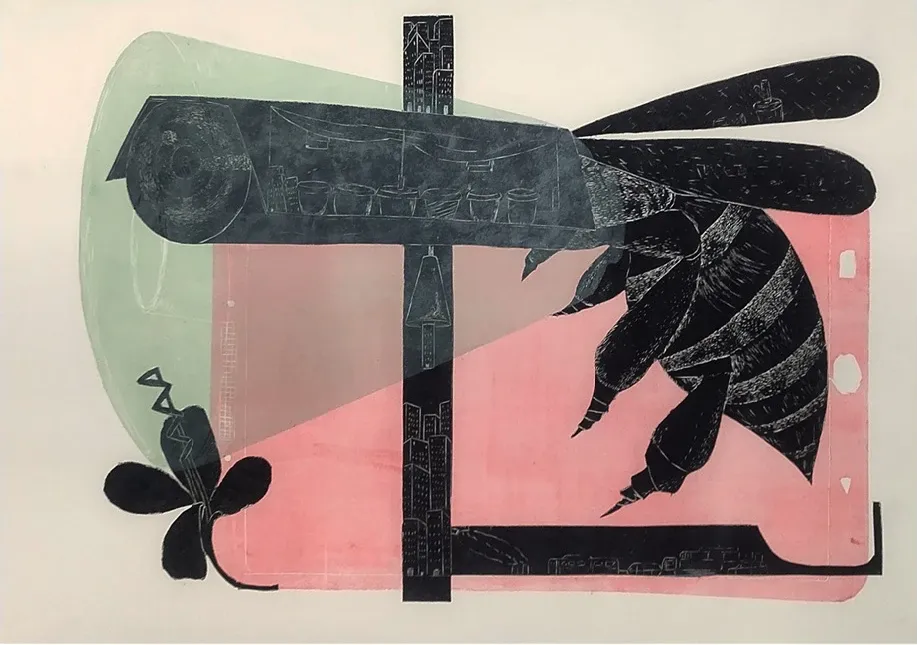
A surreal woodcut print merging a giant insect form with mechanical and architectural structures, this artwork confronts the collision of natural ecosystems and industrial urbanization, evoking a dreamlike tension between fragility and control.
Interested in this piece?
Chat on WhatsAppOr reach us directly at +91 79824 33408
Home visit available
Select artworks can be viewed at your home before you decide. A visit is ₹1,000 per artwork, fully adjusted against the purchase if you go ahead. See how it works.
Ask about a home visit for this pieceOr leave us a question about this piece
- Category
- Print Making
- Subcategory
- Woodcut
- Year
- 2024
- Dimensions
- 27 × 21 in
- Place
- Delhi
- Certificate no.
- MS-BEE-2024
Color palette
- White (36%)
- Gray (26%)
- Red (15%)
- Black (15%)
- Other (4%)
- Pink (4%)
Exact tones detected
Off WhiteOff WhiteBlackRedWhite
Description
In this striking woodcut artwork rooted in the Surrealist tradition, the artist presents a hybrid entity—a massive insect resembling a bee fused with architectural motifs and industrial elements. The creature's body appears both organic and mechanical, with segments textured like steel and embedded with faint urban structures, suggesting a dystopian metamorphosis born out of environmental disruption.
The insect dominates the composition, its wings blackened and heavy, perhaps symbolizing the burden of urbanization. The juxtaposition of soft pastel hues with the hard-edged form adds to the eerie tension. A cylindrical, industrial object resembling a megaphone or pipe juts out like a weapon or surveillance tool, pointing toward the delicate flower-like form on the left—a symbol of nature dwarfed and threatened by the imposing insect-machine.
The subtle urban skyline etched into the vertical beam and along the edges reflects a city silently colonizing all spaces—even nature. The surreal quality of the piece invites reflection on how nature is being mechanized and re-engineered to serve anthropocentric purposes, often at the cost of ecological balance.
The Surrealist influence is clear in the dreamlike fusion of unrelated forms, the disorienting scale, and the play with logic and biology. The composition feels like a stage—flattened perspective and spotlight-like color zones imply a theatrical performance, perhaps of the conflict between ecology and technology. This artwork could be read as a visual metaphor for ecological colonization, where even insects—symbols of natural systems—are now embedded with human infrastructure.
Technique Highlight
This piece is crafted using woodcut printmaking, one of the oldest relief printing techniques. The artist carved the design into a wooden surface, then applied ink to the raised areas and pressed it onto paper. This method creates bold contrasts, tactile textures, and defined edges. The layering of translucent colors over stark black forms showcases technical mastery, allowing the surreal imagery to feel both tangible and ghostly.
Historical Context
Woodcut as a medium has historically been used for both religious storytelling and political commentary. In the modern and postmodern eras, it was revived by artists like Käthe Kollwitz and M.C. Escher for its bold expression and accessibility. In the Indian context, printmaking has often carried social and political messages.
This artwork aligns with contemporary anxieties over environmental degradation, surveillance capitalism, and urban sprawl. It reflects a post-industrial age where nature is no longer sacred or separate but co-opted into human systems of control and productivity.
Color Analysis
The palette is limited and effective: black, pale green, and dusty pink. The black forms dominate, giving the work a somber, grounded weight. The pink introduces a deceptive softness, contrasting with the ominous shapes, while the green hints at fragility and life—perhaps representing nature under threat. This restrained color scheme amplifies the surreal unease and supports the central message.
Symbolism
The Insect: Traditionally a symbol of industry and order (like bees), here it is oversized and transformed—part-organic, part-industrial. It becomes a metaphor for nature reconfigured to fit human systems.
Mechanical Tube/Weapon: Suggests dominance, control, and possibly environmental exploitation or surveillance.
Delicate Flower/Plant: A remnant of untouched nature—small, vulnerable, and positioned at the mercy of the larger form.
Urban Etchings: The faint cityscape details suggest how urbanization seeps into everything, becoming inescapable even in creatures and environments once wild.
Technique
This piece is crafted using woodcut printmaking, one of the oldest relief printing techniques. The artist carved the design into a wooden surface, then applied ink to the raised areas and pressed it onto paper. This method creates bold contrasts, tactile textures, and defined edges. The layering of translucent colors over stark black forms showcases technical mastery, allowing the surreal imagery to feel both tangible and ghostly.
Historical context
Woodcut as a medium has historically been used for both religious storytelling and political commentary. In the modern and postmodern eras, it was revived by artists like Käthe Kollwitz and M.C. Escher and somnath hore for its bold expression and accessibility. In the Indian context, printmaking has often carried social and political messages. This artwork aligns with contemporary anxieties over environmental degradation, surveillance capitalism, and urban sprawl. It reflects a post-industrial age where nature is no longer sacred or separate but co-opted into human systems of control and productivity.
Symbolism
The Insect: Traditionally a symbol of industry and order (like bees), here it is oversized and transformed—part-organic, part-industrial. It becomes a metaphor for nature reconfigured to fit human systems. Mechanical Tube/Weapon: Suggests dominance, control, and possibly environmental exploitation or surveillance. Delicate Flower/Plant: A remnant of untouched nature—small, vulnerable, and positioned at the mercy of the larger form. Urban Etchings: The faint cityscape details suggest how urbanization seeps into everything, becoming inescapable even in creatures and environments once wild.
Catalogued May 1, 2025
From the same artist
More by Madhusudhan Sharma


Keep exploring
Related artworks


