

Voice of Voiceless
Pawn of Power
₹5,000
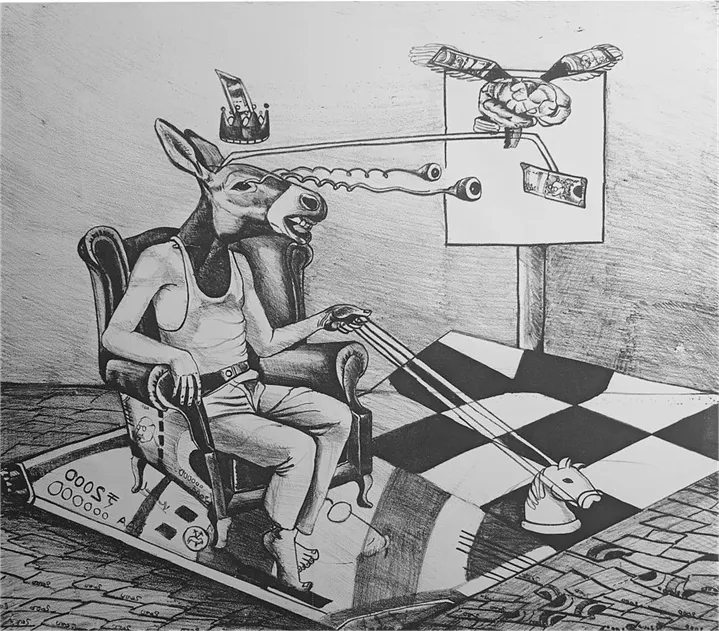
Pawn of Power is a surrealist plate lithograph depicting a donkey-headed man seated on a throne-like chair, symbolising manipulation and the illusion of control. Though he holds puppet strings, he is controlled by money, power, and social expectations. The brain, crown, and currency suggest the influence of materialism and authority, while the checkered floor evokes a strategic game in which he is both player and pawn.
Interested in this piece?
Chat on WhatsAppOr reach us directly at +91 79824 33408
Home visit available
Select artworks can be viewed at your home before you decide. A visit is ₹1,000 per artwork, fully adjusted against the purchase if you go ahead. See how it works.
Ask about a home visit for this pieceOr leave us a question about this piece
- Category
- Print Making
- Subcategory
- Lithography
- Year
- 2022
- Dimensions
- 15 × 20 in
- Place
- Delhi
- Certificate no.
- MS-Pawn of Power-2022
Color palette
- Gray (82%)
- White (15%)
- Black (3%)
Exact tones detected
WhiteLight GrayLight GrayLight GrayLight Gray
Description
Pawn of Power is a striking surrealist plate lithograph that critiques the manipulation of the common man by systems of money, politics, and media. At the center of the composition is a hybrid figure—a man with the head of a donkey—seated in a throne-like chair constructed from currency and symbols of power. This grotesque fusion suggests both submission and complicity. Traditionally associated with ignorance, stubbornness, and blind labor, the donkey here represents a populace subjugated by invisible forces.
A brain mounted on a pedestal connects to the figure via mechanical eyes and extended arms, guiding his perception and thought toward money and illusion. The subject holds puppet strings that control a toy horse on a checkered floor—a metaphor for the illusion of autonomy. While he believes himself to be the puppeteer, he is, in reality, a pawn enacting the will of larger powers. The chessboard beneath him symbolizes strategic manipulation, reducing life to a game in which he is both player and piece.
The monochromatic palette enhances the dystopian stillness of the scene, while the skewed perspective and stark contrasts evoke disorientation and psychological unrest. Crown imagery, flowing currency, and wired connections reinforce the idea of thought, vision, and action being dictated by wealth and authority.
“Pawn of Power” delivers a deeply unsettling commentary on contemporary society—exposing the psychological and systemic mechanisms that foster ignorance, exploit labor, and propagate the illusion of control. Through surreal exaggeration and dark satire, the artwork confronts the viewer with an uncomfortable truth: that many are willing participants in their own manipulation, mistaking submission for power.
Technique Highlight
This is a plate lithograph, a printmaking technique that involves drawing on a flat metal or stone plate with a greasy substance. The surface is chemically treated so that the drawing retains ink while the rest repels it. This method allows for fine detail, high contrast, and precise shading—seen here in the meticulous rendering of textures, from fur to currency to mechanical extensions.
Historical Context
Surrealism emerged in the early 20th century as a response to the irrationality of war, industrialization, and blind faith in reason. In a modern extension of this movement, this artwork critiques today’s power structures, consumerism, and media manipulation. The donkey-man recalls both Orwellian themes from Animal Farm and post-industrial alienation, resonating with contemporary societal anxieties.
Color Analysis
Rendered entirely in black and white, the absence of color intensifies the contrast and symbolism. The monochromatic palette underscores the starkness of the message—there is no gray area in the oppression and control depicted. The use of light and shadow enhances the surreal forms, giving life to unnatural combinations of anatomy and machine.
Symbolism
The donkey head serves as a potent symbol of ignorance, stubbornness, and exploitation—highlighting the figure’s blind obedience within a corrupt system. Adorned with a floating crown and surrounded by currency, the composition points to the influence of material obsession and the perversion of power. Mechanical arms and puppet strings extend from the figure, revealing a deeper loss of autonomy; though he appears to be in control, his actions are orchestrated by unseen forces. A toy horse on a checkered floor reinforces the notion of life as a manipulated game, where individuals unknowingly play the role of pawns. The brain mounted on a pedestal, wired to the figure’s eyes, suggests that even thought is under surveillance or external control. Despite these ominous forces, the seated posture of the donkey-headed man conveys a troubling sense of comfort in submission—indicating not only societal control but also willful ignorance and complacency.
Donkey Head: Symbol of ignorance, stubbornness, or exploitation.
Crown and Currency: Icons of corrupt power and material obsession.
Mechanical Arms & Puppet Strings: Loss of autonomy; illusion of control.
Toy Horse on Checkered Floor: Life as a manipulated game; the individual as a mere pawn.
Brain on Pedestal: Mind under surveillance or control.
Seated Posture: Suggests comfort in submission, willful ignorance.
Technique
This is a plate lithograph, a printmaking technique that involves drawing on a flat metal or aluminium plate with a greasy substance. The surface is chemically treated so that the drawing retains ink while the rest repels it. This method allows for fine detail, high contrast, and precise shading—seen here in the meticulous rendering of textures, from fur to currency to mechanical extensions.
Historical context
Surrealism emerged in the early 20th century as a response to the irrationality of war, industrialization, and blind faith in reason. In a modern extension of this movement, this artwork critiques today’s power structures, consumerism, and media manipulation. The donkey-man recalls both Orwellian themes from Animal Farm and post-industrial alienation, resonating with contemporary societal anxieties.
Symbolism
The donkey head serves as a potent symbol of ignorance, stubbornness, and exploitation—highlighting the figure’s blind obedience within a corrupt system. Adorned with a floating crown and surrounded by currency, the composition points to the influence of material obsession and the perversion of power. Mechanical arms and puppet strings extend from the figure, revealing a deeper loss of autonomy; though he appears to be in control, his actions are orchestrated by unseen forces. A toy horse on a checkered floor reinforces the notion of life as a manipulated game, where individuals unknowingly play the role of pawns. The brain mounted on a pedestal, wired to the figure’s eyes, suggests that even thought is under surveillance or external control. Despite these ominous forces, the seated posture of the donkey-headed man conveys a troubling sense of comfort in submission—indicating not only societal control but also willful ignorance and complacency.
Catalogued May 17, 2025
From the same artist
More by Madhusudhan Sharma


Keep exploring
Related artworks


