

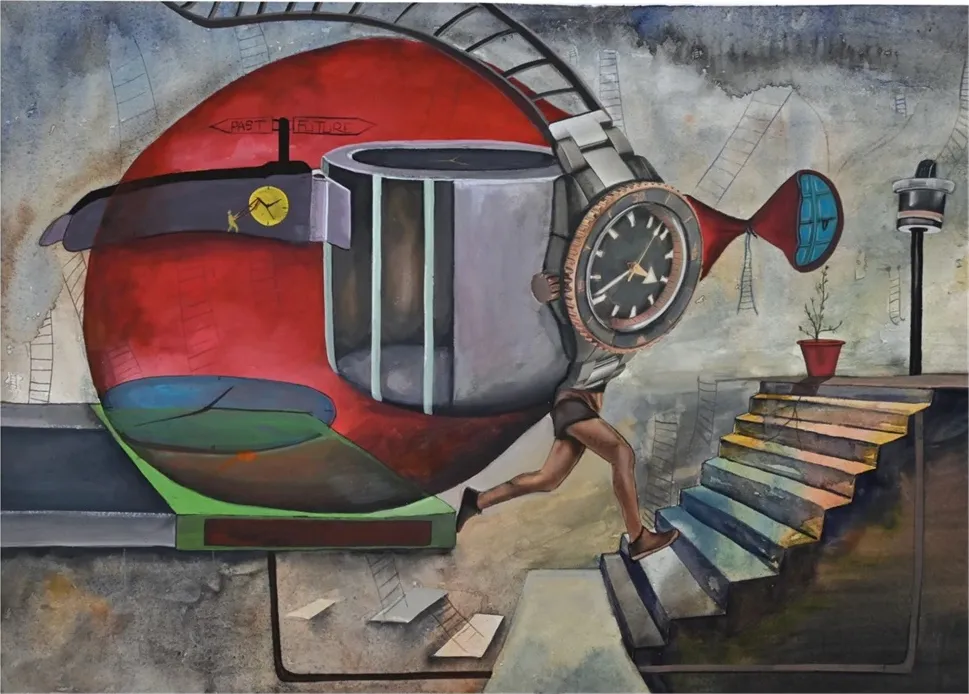
Society Of My Imagination
society of Imagination ll
₹1,20,000
This imaginative painting explores the modern human condition, where time, ambition, and the pursuit of purpose collide. Using symbolic and surreal elements like a giant time machine, ascending stairs, and disjointed human limbs, the artwork offers a critical lens on society’s relentless drive toward an uncertain future.
Interested in this piece?
Chat on WhatsAppOr reach us directly at +91 79824 33408
Home visit available
Select artworks can be viewed at your home before you decide. A visit is ₹1,000 per artwork, fully adjusted against the purchase if you go ahead. See how it works.
Ask about a home visit for this pieceOr leave us a question about this piece
- Category
- Painting
- Subcategory
- water color, Goush
- Year
- 2024
- Dimensions
- 22 × 30 in
- Place
- Delhi
- Certificate no.
- MS-Society of Imagination ll-2024
Color palette
- Gray (73%)
- Red (11%)
- Black (7%)
- Other (5%)
- White (4%)
Exact tones detected
Dark GrayGrayLight GrayDark GrayGray
Description
Society of Imagination is a surreal, conceptual painting that portrays the intersection of time, technology, ambition, and emotional struggle in a hyper-structured society. The composition centers around a fantastical machine, part-clock, part-pod, seemingly functioning as a vessel or metaphorical time capsule. Attached to it is a massive wristwatch, its dial positioned prominently where a face might be, merging the identity of the machine with the idea of time itself.
A figure is depicted climbing a staircase, but the body is fragmented—arms and torso emerging from the watch or machine, while the legs carry forward movement, suggesting physical and emotional disconnection in the face of societal expectations. The stairs ascend toward a small red potted plant—perhaps the only organic element in the painting—indicating a fragile sense of hope or renewal.
The background is scattered with floating, disoriented ladders and sheets of paper, reinforcing a dreamlike atmosphere and suggesting disarray in thought, ambition, and knowledge. A sign pointing to “Past” and “Future” adds another layer of psychological tension, placing the character in a perpetual limbo between memory and anticipation.
This painting embodies the struggle of the contemporary individual within an imagined society where every move is calculated, timed, and directed—leaving little room for spontaneity, emotion, or rest.
Technique Highlight
Style: Surrealism with collage-inspired spatial fragmentation
Medium: Likely acrylic or watercolor on paper or canvas
Execution:
Blending of architectural and mechanical forms with organic human movement
Smooth transitions in gradient for a dreamlike effect
Emphasis on exaggerated scale (e.g., oversized clock) to highlight dominant themes
Layered imagery with sharp contours and soft backgrounds to guide visual flow
Historical Context
This work draws inspiration from both early 20th-century surrealism and modern social commentary. Artists like Salvador Dalí used melting clocks to reflect on the fluidity of time, and this painting follows that lineage by reimagining time not just as fluid, but oppressive and mechanical. In the context of post-industrial and post-digital societies, particularly in developing nations like India, the tension between tradition, modernity, and relentless ambition has inspired a new visual language—one that this painting taps into profoundly.
Color Analysis
Muted Grays and Beiges (background): Evoke urban monotony, lifeless routine
Vibrant Reds and Maroons (central pod): Indicate urgency, anxiety, and dominance of mechanical systems
Earthy Skin Tones (figure): Add humanity amidst mechanical coldness
Cool Tones in Stairs (blues, purples, yellows): Suggest uncertainty, transition, emotional ups and downs
Green and Blue (plant pot, machine parts): Provide contrast—symbolizing life and potential beyond control
Symbolism
Clock/Watch: Time as a societal constraint; the loss of personal identity to rigid schedules
Staircase: The journey of ambition, self-improvement, or escape—often challenging and fragmented
Potted Plant: A symbol of nature, simplicity, and quiet hope in a chaotic system
Ladders and Floating Papers: Illusions of opportunity, unstable dreams, knowledge that lacks grounding
Directional Sign (Past ↔ Future): A crossroads; the paralyzing tension between nostalgia and anticipation
Technique
The artwork is executed in a surrealist style with a strong influence of painting with collage-inspired spatial fragmentation, creating a disjointed yet cohesive visual narrative. The medium, likely acrylic or watercolor on paper or canvas, allows for both bold contrasts and delicate transitions. The artist skillfully blends architectural and mechanical forms with hints of organic human movement, creating a tension between structure and life. Smooth gradient transitions lend the composition a dreamlike, almost fluid atmosphere, while the use of exaggerated scale—such as an oversized clock—draws attention to central themes like time, dominance, or urgency. The visual flow is carefully directed through layered imagery, where sharp contours contrast with soft backgrounds, guiding the viewer's eye across symbolic zones and reinforcing the surreal tension between reality and imagination.
Historical context
This work draws inspiration from both early 20th-century surrealism and modern social commentary. Artists like Salvador Dalí used melting clocks to reflect on the fluidity of time, and this painting follows that lineage by reimagining time not just as fluid, but oppressive and mechanical. In the context of post-industrial and post-digital societies, particularly in developing nations like India, the tension between tradition, modernity, and relentless ambition has inspired a new visual language—one that this painting taps into profoundly.
Symbolism
In this artwork, various elements symbolize the complex tension between personal identity and societal expectations. The clock/watch represents time as a rigid societal constraint, highlighting the loss of individuality to the pressures of structured schedules. The staircase embodies the challenging journey of ambition or self-improvement, often fragmented and difficult, symbolizing the pursuit of success or escape. The potted plant offers a subtle counterpoint—representing nature, simplicity, and quiet hope amidst the chaos of a demanding system. Ladders and floating papers suggest fleeting opportunities, unstable dreams, and knowledge that lacks solid grounding, reflecting the precariousness of progress. Finally, the directional sign (Past ↔ Future) marks a crossroads, capturing the paralyzing tension between nostalgia for what’s been and anticipation for what’s to come, further underscoring the struggle to navigate between what is and what could be. 4o mini
Composition analysis
The composition is highly dynamic, dominated by diagonal lines and circular forms. The large red pod acts as a gravitational center, drawing the viewer’s focus before leading the eye upward along the staircase. The segmented human figure both grounds and destabilizes the narrative, while background elements float with no clear vanishing point, enhancing the dreamlike unease. The contrast between mechanical structure and soft organic details creates a visual and thematic duality.
Cultural significance
This painting mirrors the psychological climate of contemporary society, especially in rapidly urbanizing cultures. It reflects the anxiety of youth trapped in cycles of productivity, the conflict between technological advancement and emotional exhaustion, and the devaluation of nature and human connection. In Indian society, where tradition coexists with accelerating modernity, this work resonates deeply—questioning whether our imagined futures are truly liberating or just more sophisticated forms of confinement.
Catalogued May 5, 2025
From the same artist
More by Madhusudhan Sharma


Keep exploring
Related artworks


