
Other
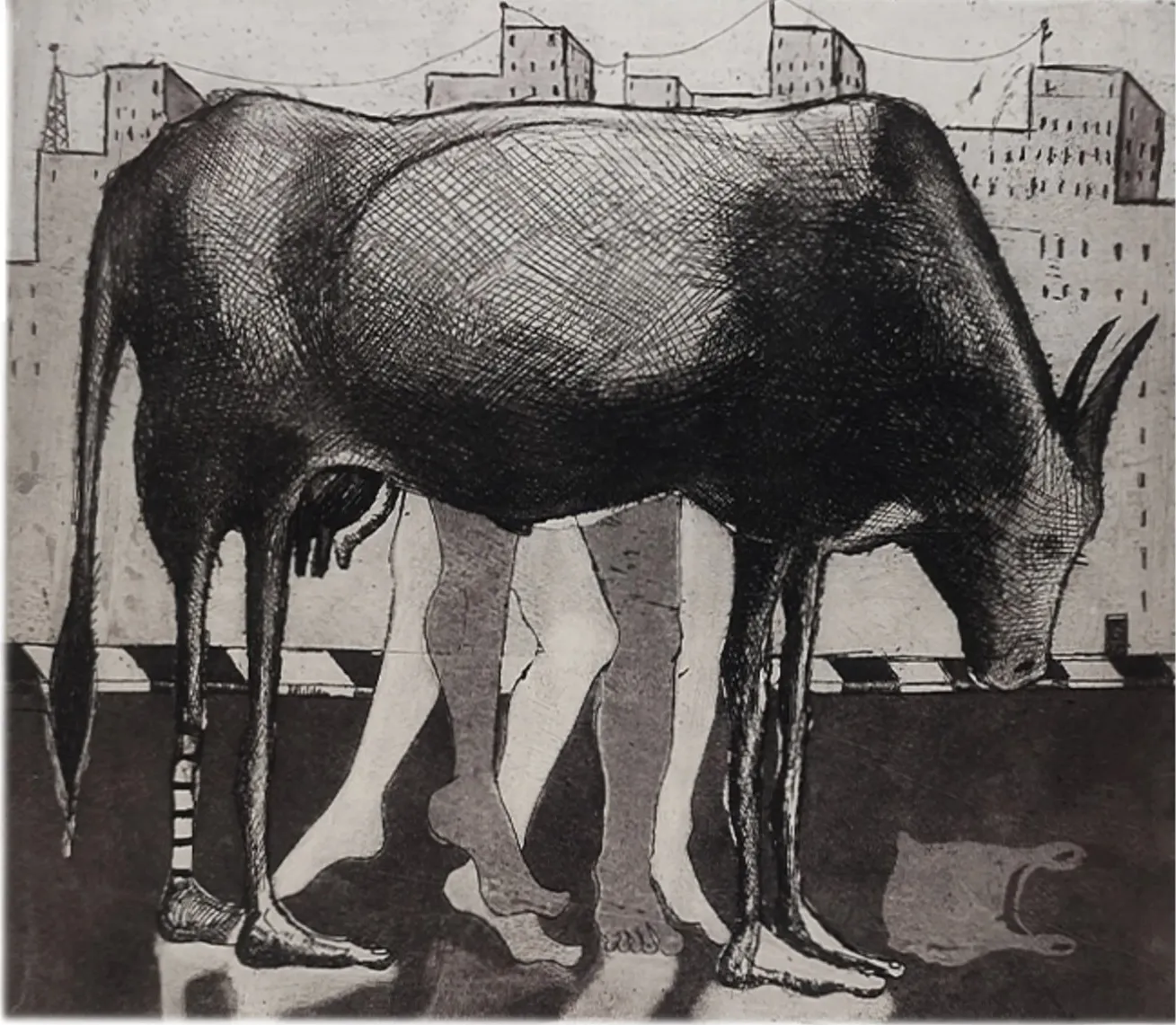
Cow in City V
₹60,000
In this surreal etching, a hybrid creature composed of a cow's body and human legs walks through a stark urban landscape, merging animal and human forms to explore themes of coexistence, exploitation, and blurred identity in a rapidly urbanizing world.
Interested in this piece?
Chat on WhatsAppOr reach us directly at +91 79824 33408
Home visit available
Select artworks can be viewed at your home before you decide. A visit is ₹1,000 per artwork, fully adjusted against the purchase if you go ahead. See how it works.
Ask about a home visit for this pieceOr leave us a question about this piece
- Category
- Print Making
- Subcategory
- Etching
- Year
- 2024
- Dimensions
- 10 × 10 in
- Place
- Delhi
- Certificate no.
- MS-COW-5-2024
Color palette
- Gray (72%)
- Black (20%)
- White (8%)
Exact tones detected
Dark GrayBlackBlackWhiteLight Gray
Description
This powerful monochromatic etching captures a surreal fusion of a cow's torso and head with multiple human legs, all moving in unison. The backdrop consists of abstracted urban buildings, which evoke the impersonal architecture of modern cities. The animal’s form, rendered in strong, crosshatched strokes, dominates the composition, while the human legs beneath it suggest motion, burden, or submission.
The hybrid nature of the creature challenges the viewer’s sense of realism and demands a symbolic interpretation. The cow, sacred and maternal in many cultures, especially in India, is shown here as a vessel—or perhaps a burden—shared by multiple human figures. The disjointed legs beneath it seem to indicate humans carrying or becoming the animal, as if tied to its fate.
One leg is bandaged or artificially marked, referencing injury, constraint, or medicalization—possibly a nod to how both animals and humans are affected by the strain of urban environments. The shadow beneath the cow is stylized, warped into an ambiguous shape, reinforcing the idea of distorted identity or lingering trauma.
The urban setting further heightens the contrast between traditional life (represented by the cow) and modernity’s mechanization and alienation. The cityscape looms passively in the background, dotted with power lines and geometric windows, underscoring a sense of detachment from nature.
Overall, the work suggests a deep commentary on human-animal entanglement, cultural symbolism, and the cost of modernization. It is both poetic and unsettling a reflection of how urban progress consumes and distorts organic life.
Technique Highlight
This piece uses etching, a traditional printmaking technique that allows for exquisite detail and expressive linework. The artist employs crosshatching and varied line pressure to define the textures of both animal hide and human skin, while also achieving strong tonal contrast in the architectural backdrop. The crispness of the etched lines and subtle value gradations enhance the surreal, dreamlike quality of the image.
Historical Context
This work stands within the surrealist tradition, which emerged in the early 20th century to explore subconscious and irrational imagery, often influenced by Freud and post-war anxieties. In a contemporary South Asian context, this surrealism gains new relevance: the tension between tradition (the cow as a sacred symbol) and urban life (the generic buildings) reflects the dissonance faced by both people and animals amid modernization. The blending of forms reflects broader concerns about environmental degradation, displacement, and cultural erosion.
Color Analysis
- Monochrome palette: The grayscale palette conveys starkness and seriousness, reinforcing the surreal unease and emotional gravity of the image.
- Line and tone dominance: Rather than relying on color, the artist creates tension and depth through strong contrasts between black ink and the exposed white of the paper.
Symbolism
- Cow Body: Represents tradition, nourishment, spirituality, and exploitation. In the surreal context, it also becomes a vessel or mask.
- Human Legs: Suggest dependency, burden, or shared destiny. They may symbolize how humans carry the weight of their own systems—be it culture, guilt, or consequences of urbanization.
- Bandaged/marked leg: Indicates injury or correction, possibly suggesting systemic harm or forced adaptation.
- Urban Buildings: Impersonal, looming, and repetitive—stand in contrast to the organic form of the hybrid creature, representing the encroachment of city life on nature.
- Distorted Shadow: A reflection of broken identity or symbolic trauma—what remains of the creature's true form?
Technique
This piece uses etching, a traditional printmaking technique that allows for exquisite detail and expressive linework. The artist employs crosshatching and varied line pressure to define the textures of both animal hide and human skin, while also achieving strong tonal contrast in the architectural backdrop. The crispness of the etched lines and subtle value gradations enhance the surreal, dreamlike quality of the image.
Historical context
This work stands within the surrealist tradition, which emerged in the early 20th century to explore subconscious and irrational imagery, often influenced by Freud and post-war anxieties. In a contemporary South Asian context, this surrealism gains new relevance: the tension between tradition (the cow as a sacred symbol) and urban life (the generic buildings) reflects the dissonance faced by both people and animals amid modernization. The blending of forms reflects broader concerns about environmental degradation, displacement, and cultural erosion.
Symbolism
The cow’s body in the image serves as a multifaceted symbol, embodying tradition, nourishment, and spirituality, while also hinting at exploitation—a creature revered yet commodified. In this surreal composition, it transforms into a vessel or mask, perhaps obscuring or distorting its true nature. The human legs attached to the cow suggest a forced symbiosis, illustrating dependency or a shared, burdensome fate. They may represent how humanity carries the weight of its own systems—whether cultural, economic, or ecological—blurring the line between the natural and the constructed. One leg, bandaged or marked, introduces a note of injury or intervention, implying systemic harm, forced adaptation, or an attempt at "correcting" what has been broken. Looming in the background, the urban buildings stand rigid and repetitive, their impersonal architecture clashing with the organic hybrid in the foreground. They symbolize the relentless encroachment of urbanization, swallowing landscapes and reshaping identities. Meanwhile, the distorted shadow cast by the creature speaks to fragmented identity or unseen trauma—what is left unspoken, erased, or twisted in the process of assimilation. Together, these elements create a haunting commentary on displacement, exploitation, and the uneasy fusion of natural and artificial worlds.
Catalogued May 2, 2025
From the same artist
More by Madhusudhan Sharma


Keep exploring
Related artworks


