

Society Of My Imagination
Society of Imagination
₹1,20,000
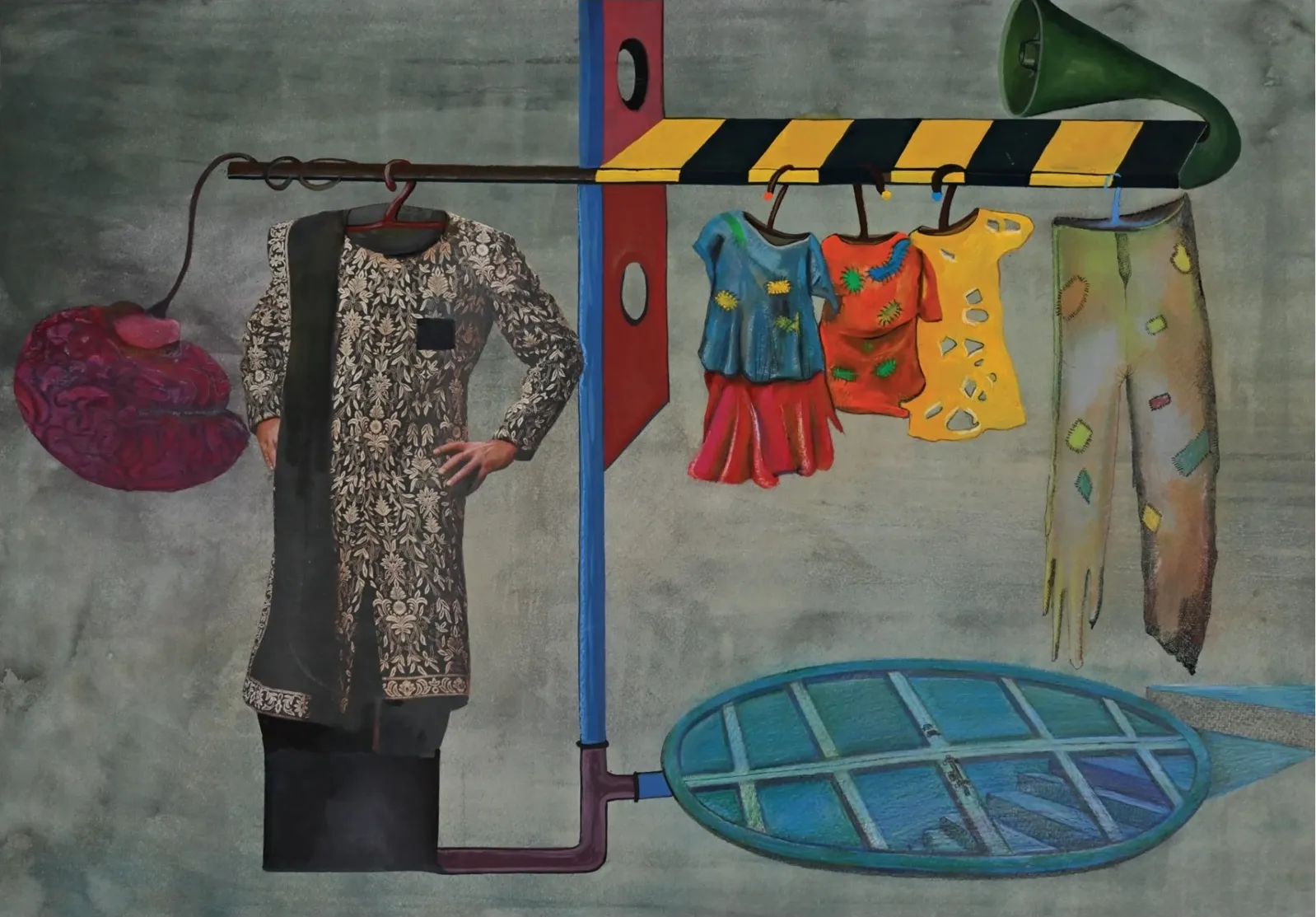
This surreal, collage-style painting uses a mix of traditional clothing, torn fabrics, machines, and body parts to question the way society is structured. It highlights issues like class differences, loss of identity, and how people are treated like machines in a world focused on consumption and materialism.
Interested in this piece?
Chat on WhatsAppOr reach us directly at +91 79824 33408
Home visit available
Select artworks can be viewed at your home before you decide. A visit is ₹1,000 per artwork, fully adjusted against the purchase if you go ahead. See how it works.
Ask about a home visit for this pieceOr leave us a question about this piece
- Category
- Painting
- Subcategory
- water colour,acrylic,goush,collage
- Year
- 2024
- Dimensions
- 22 × 30 in
- Place
- Delhi
- Certificate no.
- MS-Society of Imagination -2024
Color palette
- Gray (70%)
- Teal (6%)
- Black (5%)
- Red (5%)
- White (4%)
- Blue (4%)
- Other (3%)
- Brown (3%)
Exact tones detected
GrayGrayGrayGrayDark Gray
Description
Society of Imagination is a thought-provoking painting that uses the visual language of painting with collage to explore the fractured nature of modern social identity. The artwork is structured around a central “clothesline” motif, from which hangs a series of disparate garments—each symbolizing different strata of society. A richly embroidered sherwani (traditional male attire) with inserted human arms stands in stark contrast to the adjacent torn, patchy clothes that hang lifelessly beside it.
To the left, a large anatomical heart is connected via a tube to the figure, suggesting an externalized, perhaps mechanized, control of emotion or life itself. This heart is not within the body—it is visible, tethered, and vulnerable, implying that society demands a detachment from one’s core essence. To the right, a megaphone-like horn emerges, hinting at propaganda, social expectations, or the loud voice of the collective dictating behavior.
Beneath it all, a large blue manhole cover lies on the ground, partially open, evoking themes of hidden labor, marginalization, and the overlooked underbelly of society. A traffic barrier adds another layer of metaphor—of social checkpoints, control, and division.
The painting does not conform to linear narrative or realistic space. Instead, it invites the viewer to assemble meaning from visual fragments—much like society is built from clashing ideas, systems, and lived experiences.
Technique Highlight
Style: Collage-inspired surrealism with hyperreal and abstract elements
Medium: Likely mixed media or acrylic on paper/canvas
Methods:
Trompe-l'œil effects for realism in fabrics and organs
Symbolic juxtaposition using isolated forms in flat or ambiguous spatial arrangements
Clean edges, stylized shadows, and contrasting textures add to the collage illusion
Historical Context
Collage art gained popularity during the early 20th century, notably in Cubism and Dada movements, as a response to modernity, war, and fragmented realities. In Indian contemporary art, collage-like compositions often reflect the tensions of urbanization, caste/class conflict, and hybrid identities.
This work follows in that tradition, reflecting a post-liberalization Indian society where Western consumerism, traditional values, and class divides all collide in the imagination of the individual.
Color Analysis
Grey Background: Neutral and industrial, setting a mechanical, impersonal tone.
Bright Primary Clothing (red, yellow, blue): Represents childhood or working-class labor, possibly referencing informal economy or discarded dreams.
Embroidered Sherwani (gold/black): Suggests luxury, formality, and inherited privilege.
Heart (deep red): Visceral and emotional intensity; also vulnerability.
Manhole (blue-green): Cold, mechanical, and suggestive of hidden depths or unacknowledged labor.
Symbolism
Sherwani with human arms: Represents status and facade—identity constructed through attire, not essence.
Torn and patched garments: Symbolize poverty, survival, and social neglect.
Anatomical heart outside the body: Emotional detachment, mechanization of humanity, or sacrifice.
Traffic barrier: Social boundaries, rules, restrictions.
Loudspeaker/horn: Imposed societal voice, pressure to conform, or propaganda.
Manhole cover: The ignored “underground” of society—manual laborers, sanitation workers, or hidden systems.
Technique
The artwork employs a painting with collage-inspired surrealism, blending hyperreal and abstract elements to create a visually arresting and conceptually layered composition. Executed likely in mixed media or acrylic on paper or canvas, the piece utilizes a range of techniques to blur the boundaries between realism and symbolism. Trompe-l'œil effects are used to achieve striking realism in details like fabrics and anatomical overlays, enhancing the illusion of depth and texture. The composition features symbolic juxtapositions, with isolated forms placed in flat or ambiguous spatial arrangements that challenge traditional perspective and narrative coherence. Clean edges, stylized shadows, and contrasting textures further amplify thepainting and collage-like aesthetic, giving the work a constructed, almost cut-and-pasted quality that reinforces its surreal and fragmented message.
Historical context
Collage-style with painting gained prominence in the early 20th century, particularly through movements like Cubism and Dadaism, as artists responded to the chaos of modernity, war, and fractured realities. In contemporary Indian art, collage-inspired compositions have become a powerful tool to explore themes such as urbanization, caste and class tensions, and hybrid cultural identities. This artwork continues in that tradition, reflecting the complexities of post-liberalization Indian society, where Western consumerism, traditional values, and deep socio-economic divides intersect and clash within the individual's lived experience and imagination.
Symbolism
This artwork incorporates surreal and symbolic elements to critique social structures and human identity. The sherwani with human arms suggests a constructed identity rooted in status and appearance, where the outward show of power replaces inner essence. In contrast, the torn and patched garments speak to poverty, resilience, and the neglect of marginalized communities. The anatomical heart placed outside the body evokes emotional detachment and the dehumanizing effects of mechanization, while also hinting at themes of vulnerability or sacrifice. A traffic barrier stands as a symbol of societal restrictions, rules, and exclusion, delineating who is allowed to move freely and who is not. The loudspeaker or horn represents the imposition of dominant societal narratives, the pressure to conform, or the constant noise of propaganda. Finally, the manhole cover serves as a quiet but powerful metaphor for the overlooked foundations of society—manual laborers, sanitation workers, and the hidden systems that sustain urban life but remain unacknowledged.
Composition analysis
The painting follows a horizontal visual flow, guided by the linear hanging structure acting like a clothesline or rail. This creates a narrative sequence—from life (the heart) to identity (the sherwani) to suppression (barriers and loudspeakers) to the discarded (tattered clothes and manhole). The objects are isolated yet connected through pipes, hooks, and lines, suggesting invisible societal forces binding everything. The lack of depth and flat backdrop accentuates the sense of being “pinned” or staged—emphasizing artifice and performance in social identity.
Cultural significance
This work speaks to the social imagination of a postcolonial, capitalist Indian society, where identity is increasingly constructed through external signs—clothing, voice, class visibility—rather than inner truth. It critiques consumerism, class disparity, and the way tradition is used selectively to project status while marginalizing others. The collage approach mirrors the fractured, pieced-together nature of modern identity and invites viewers to reimagine a society where emotion, labor, and identity are fully integrated—not externalized or hidden.
Catalogued May 5, 2025
From the same artist
More by Madhusudhan Sharma


Keep exploring
Related artworks


