
Voice of Voiceless
Inherited Burden
₹80,000
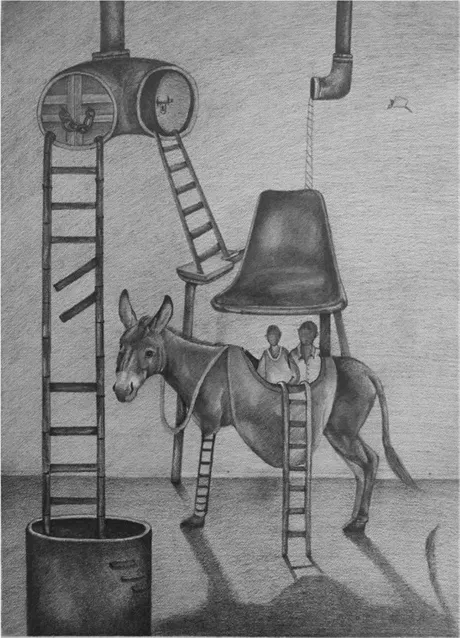
Inherited Burden is a surrealist drawing depicting the cycle of labour, poverty, and responsibility passed from one generation to another. Two children riding a donkey symbolise inherited struggle, while broken ladders and mechanical structures represent fragmented and inaccessible progress. The work questions how hardship becomes normalised and encourages breaking free from this cycle through conscious choices.
Interested in this piece?
Chat on WhatsAppOr reach us directly at +91 79824 33408
Home visit available
Select artworks can be viewed at your home before you decide. A visit is ₹1,000 per artwork, fully adjusted against the purchase if you go ahead. See how it works.
Ask about a home visit for this pieceOr leave us a question about this piece
- Category
- Drawing
- Subcategory
- Graphite on paper
- Year
- 2024
- Dimensions
- 11 × 15 in
- Place
- Delhi
- Certificate no.
- MS-Inherited Burden -2024
Color palette
- Gray (92%)
- White (8%)
Exact tones detected
GrayLight GrayLight GrayLight GrayGray
Description
"Inherited Burden" is a compelling surrealist artwork that captures the grim reality of generational poverty, labor, and systemic stagnation. At its heart, a donkey—long associated with relentless work and servitude—carries two young children, symbolizing how struggle begins early and is passed down like inheritance. These children are not playing or learning; instead, they are already burdened, illustrating how society molds future generations into the same cycles of hardship.
Scattered across the composition are multiple ladders, traditionally symbols of progress or escape. But here, they are broken, misaligned, or absurdly tied to the donkey’s legs—offering neither direction nor hope. These dysfunctional ladders become metaphors for false promises of upward mobility, reinforcing the idea that the system is rigged to keep the poor from rising.
Above, a mechanical structure with a suspended chair mocks the notion of success or comfort—it’s visible, even tangible, but deliberately inaccessible. Below, an empty barrel evokes fatigue, hollowness, and emotional depletion. The industrial textures and disconnected structures amplify a sense of mechanized suffering, where life becomes repetitive and dehumanizing.
This haunting scene critiques the way children are often born into cycles of survival, with little say in their futures. Dreams are deferred or distorted, replaced by the urgency to endure. The work invites viewers to question the societal structures that normalize such repetition and to rethink a world where hardship is inherited rather than alleviated.
Technique Highlight:
Rendered with meticulous graphite shading, the drawing demonstrates excellent tonal control, depth, and texture. Surrealism is emphasized through the unnatural combinations of forms and objects, along with skewed proportions and ambiguous space, reinforcing the discomfort and thematic weight.
Historical Context:
The artwork reflects a larger narrative in post-industrial and developing societies, especially in urban and rural India, where economic hardship leads to child labor and the generational transmission of poverty. The donkey, often a domestic labor animal, becomes a stand-in for the exploited working class.
Color Analysis:
Though monochromatic, the grayscale palette intensifies the bleakness and sense of entrapment. The absence of bright or hopeful tones further reinforces the idea that vitality, joy, and escape have been drained from this cycle of life.
Symbolism:
The surrealist composition uses potent symbols to critique the inherited nature of struggle. The donkey stands as a timeless emblem of labor, burden, and generational exploitation, forced to carry not just physical loads, but the weight of systemic injustice. The children riding its back reflect how future generations are conditioned into the same cycle, inheriting struggle instead of opportunity. Ladders, often associated with ambition and escape, appear broken or misplaced, representing false hope and a system that keeps progress out of reach. Cold industrial mechanisms dominate the space, emphasizing how hardship is manufactured and maintained by rigid societal structures. The barrel and pipe suggest emotional and material emptiness—an unyielding cycle of exhaustion. Suspended above, the chair symbolizes the illusion of comfort or success—visible, but deliberately kept out of reach—reminding us that for many, security remains a distant, unattainable dream.
Donkey: Symbol of labor, burden, and generational exploitation.
Children: Future generations trapped in the same conditions as their predecessors.
Ladders: False hope, broken systems, or unreachable progress.
Industrial Mechanisms: The systematization of hardship and the cold machinery of social structures.
Barrel/Pipe: Emptiness, loss, and potentially a symbol of exhaustion or futility.
Chair suspended above: Comfort or status that is present but inaccessible.
Technique
Rendered with meticulous graphite shading, the drawing demonstrates excellent tonal control, depth, and texture. Surrealism is emphasized through the unnatural combinations of forms and objects, along with skewed proportions and ambiguous space, reinforcing the discomfort and thematic weight.
Historical context
The artwork reflects a larger narrative in post-industrial and developing societies, especially in urban and rural India, where economic hardship leads to child labor and the generational transmission of poverty. The donkey, often a domestic labor animal, becomes a stand-in for the exploited working class.
Symbolism
The surrealist composition uses potent symbols to critique the inherited nature of struggle. The donkey stands as a timeless emblem of labor, burden, and generational exploitation, forced to carry not just physical loads, but the weight of systemic injustice. The children riding its back reflect how future generations are conditioned into the same cycle, inheriting struggle instead of opportunity. Ladders, often associated with ambition and escape, appear broken or misplaced, representing false hope and a system that keeps progress out of reach. Cold industrial mechanisms dominate the space, emphasizing how hardship is manufactured and maintained by rigid societal structures. The barrel and pipe suggest emotional and material emptiness—an unyielding cycle of exhaustion. Suspended above, the chair symbolizes the illusion of comfort or success—visible, but deliberately kept out of reach—reminding us that for many, security remains a distant, unattainable dream.
Catalogued May 8, 2025
From the same artist
More by Madhusudhan Sharma


Keep exploring